


Panel and Workshop
Workshop 1 (QuantHub): How AI Is Changing What It Means to Be a Professor
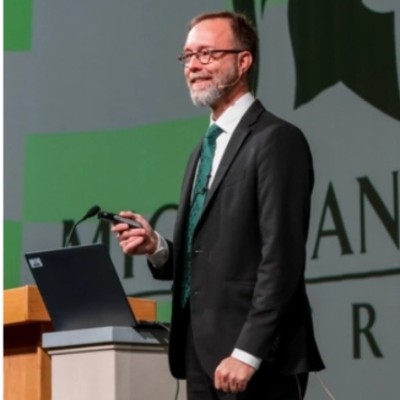
Session Description: MIS and IS faculty are preparing students for a profession being reshaped by AI while navigating changes to their own work. Beyond questions about student use and academic integrity, what does AI mean for faculty workload, wellbeing, professional identity, and career advancement?
In this session, Dr. Wes Fondren examines the human side of AI’s impact on higher education, including the pressures of keeping pace with technology, shifting expectations for teaching and research, and emerging questions about tenure and how faculty contributions are valued. Participants will consider what these changes mean for their careers, their departments, and the future of the professoriate.
Speaker bio: Dr. Wes Fondren works with QuantHub and universities on the changing role of AI in higher education. He has served as associate provost for artificial intelligence, academic technology, and professional development at Coastal Carolina University, as well as an associate professor of communication, department chair, and associate dean. His background combines two decades in the technology sector with experience in teaching, academic leadership, and faculty development. He holds a Ph.D. in communication and information science from the University of Alabama, with a specialization in cognitive psychology.
Panel 1: AI In Business/Analytics Coursework
Session Description: This panel session will share experiences and insights from experiments involving the introduction of artificial intelligence into coursework. SIGDSA members have been teaching and researching related algorithms and applications under various names for many years, including statistics, pattern recognition, data mining, business intelligence, analytics, data science, machine learning, and artificial intelligence. However, the recent growth of AI has created greater opportunities to introduce these techniques and applications into every aspect of personal, professional, and organizational life.
This session will provide a brief overview of how SIGDSA scholars have introduced these technologies at different levels. From our perspective, these efforts can be grouped into three levels: global, meaning the university or business school level; local, meaning the information systems program level; and hyperlocal, meaning the business analytics or data science coursework level. SIGDSA scholars will highlight the topics they have covered and share their experiences at one or more of these levels. The panel will also invite audience members to share their own experiences. In addition, the panel hopes to compile and share teaching resources that interested faculty members can use when developing their course plans.
Panel Moderator: Ramesh Sharda, Oklahoma State University.
Panelists: Rachel Chung, Carnegie Mellon University; Ashish Gupta, Auburn University; Lakshmi Iyer, University of North Carolina Greensboro; Vic Matta, Ohio University; Karthik Srinivasan, University of Kansas; and Gloria Phillips-Wren, Loyola University Maryland.
Panel 2: AI Risks and Responsible Adoption: Preventing AI Fallout
Session Description: This panel examines the risks and challenges associated with the adoption of artificial intelligence in organizations and higher education. Panelists will discuss issues such as inaccurate or biased outputs, privacy and security concerns, ethical decision-making, overreliance on AI, and the potential effects of AI on individuals and institutions. The discussion will also consider practical strategies for responsible AI adoption, including appropriate oversight, transparency, accountability, and human involvement in AI-supported decisions.
Panel Moderator: Arman Falahati, University at Buffalo, USA; Ciara Heavin, University College Cork, Ireland.
Panelists: Raj Sharman, University at Buffalo, USA; Ashish Gupta, Auburn University, USA; Luvai Motiwalla, University of Massachusetts Lowell, USA; Gurpreet Dhillon, University of Nebraska at Omaha, USA; Aleš Popovič, NEOMA Business School, France.